
Imiquimod
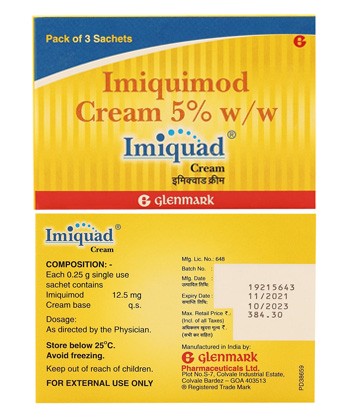
Imiquimod
- In our pharmacy, you can buy imiquimod without a prescription, with discreet delivery throughout Australia. Prescription-only status may still apply under Australian law, so please check local regulations before purchase.
- Imiquimod is used for actinic keratosis, superficial basal cell carcinoma, and external genital or perianal warts. It is an immune response modifier that stimulates local production of interferons and other cytokines to help the body fight abnormal or virus-infected cells.
- The usual dose depends on the condition: for actinic keratosis, apply a thin layer 2 times per week; for superficial basal cell carcinoma, apply 5 times per week; and for external genital or perianal warts, apply 3 times per week on alternate days.
- The form of administration is topical cream, most commonly 5% cream in single-use sachets, and also 3.75% cream in tubes or sachets.
- Imiquimod does not work immediately; local skin changes may begin within days, while the full treatment response is usually seen over several weeks.
- The duration of action depends on the indication and treatment course, typically about 8 hours after each application on the skin, with treatment lasting 6 to 16 weeks overall.
- Avoid alcohol if it worsens skin irritation or flu-like symptoms. There is no specific direct alcohol interaction listed, but it is best to use caution.
- The most common side effects are local skin reactions such as redness, swelling, itching, burning, erosion, scabbing, flaking, and pain; headache and flu-like symptoms can also occur.
- Would you like to try imiquimod without a prescription?
Basic Imiquimod Information
- INN (International Nonproprietary Name): Imiquimod
- Brand Names Available in Australia: Aldara
- ATC Code: D06BB10
- Forms & Dosages: Cream 5% (50 mg/g, 12.5 mg/250 mg) and cream 3.75%
- Manufacturers in Australia: not specified
- Registration Status in Australia: prescription-only (Rx)
- OTC / Rx Classification: prescription-only (Rx)
What Recent Trials And Guideline Shifts Mean For Imiquimod
Has your doctor suggested imiquimod cream and you want to know whether it still stacks up against newer and older treatments?
That is a fair question, especially when treatment can take weeks and the skin reaction looks worse before it looks better.
Across 2022 to 2025, the main trend in studies has been the same: imiquimod works best when patients stick to the schedule, tolerate the expected inflammation, and complete the course.
For actinic keratosis, superficial basal cell carcinoma, and external genital or perianal warts, recent evidence continues to support the role of imiquimod 5% cream and imiquimod 3.75% as useful prescription options, particularly where a self-applied treatment is preferred.
Comparative studies and practice trends still place 5-fluorouracil and cryotherapy as common alternatives for actinic keratosis, while podophyllotoxin remains a familiar wart treatment.
Australian data are limited, so local use still relies heavily on international evidence and dermatology practice patterns here at home.
Main outcomes matter: adults apply a thin layer, actinic keratosis is usually treated twice weekly for 16 weeks, superficial basal cell carcinoma five times weekly for 6 weeks, and external genital or perianal warts three times weekly for up to 16 weeks.
Clearance rates improve when patients do not skip doses, and tolerability is usually acceptable if counselling is good and expectations are realistic.
Safety observations from TGA-style reporting: local redness, swelling, erosion, scabbing, and itching are the main issues, while systemic symptoms such as headache or flu-like symptoms are uncommon.
Because imiquimod is prescription-only in Australia, pharmacist counselling is important for setting expectations about skin reactions and when to seek review.
How Imiquimod Works In The Skin
Wondering why this cream is used for viral warts and some sun-damaged skin lesions rather than as a simple antiviral?
Imiquimod is best understood as an immune response modifier.
It does not work like an antibiotic, and it does not directly kill viruses in the usual sense.
Instead, it switches on local skin immunity so the body can clear abnormal or virus-infected cells more effectively.
On a scientific level, imiquimod induces interferon and cytokines, which then activate local immune pathways in the skin.
It is classified under ATC code D06BB10 as a topical antiviral and chemotherapeutic dermatological agent.
That mechanism explains three practical things patients often notice.
First, response can be delayed rather than immediate.
Second, inflammation at the application site is expected and often means the drug is doing its job.
Third, treatment should usually be completed even if the skin looks irritated early on, unless a clinician advises otherwise.
Where Imiquimod Fits In Australian Use
Is it available over the counter in Australia, or do you need a prescription?
Imiquimod is prescription-only in Australia, with access through prescriber scripts and pharmacy dispensing, including online pharmacy services that can fill valid e-scripts.
In practice, community pharmacies and telehealth pathways matter because many people want quick access after a GP or skin cancer review.
A small number of specialist-led off-label uses may be considered in Australian practice when standard options are unsuitable, but this needs careful supervision.
That is especially important in children and in immunocompromised patients, where routine use is generally avoided or handled case by case.
Common brand references include Aldara 5% cream and Zyclara 3.75% cream, while international markets also use names such as Imiquad, Beselna, Nilwart, and Imimore.
Packaging is typically in single-use sachets, which helps with dosing clarity and reduces contamination risk.
How To Use It Safely And Correctly
People often ask whether they should “put on more to make it work faster”.
The answer is no.
Apply a thin layer only to the affected area, and avoid overuse, broken skin, and mucous membranes.
If a dose is missed, apply it as soon as remembered unless the next dose is close, then skip the missed application.
For actinic keratosis, the adult regimen is twice weekly for 16 weeks, with the cream left on for about 8 hours.
For superficial basal cell carcinoma, the adult regimen is five times weekly for 6 weeks, again leaving it on for about 8 hours.
For external genital or perianal warts, use is three times weekly on alternate days for up to 16 weeks, with a contact time of 6 to 10 hours.
No routine elderly dose adjustment is needed.
No established renal or hepatic dose adjustment is listed, but caution is sensible if irritation or systemic effects seem stronger than expected.
Paediatric use is generally not recommended under 12 years, except in special cases and under guideline-based advice.
What Side Effects And Precautions Matter Most
Are the redness and flaking normal, or is this an allergy?
Local skin reactions are the main thing to expect with imiquimod.
Redness, swelling, erosion, scabbing, flaking, itching, burning, and pain are all recognised effects.
These reactions can be uncomfortable, but they are often part of the expected treatment response.
Uncommon systemic effects include headache, flu-like symptoms, myalgia, and fatigue.
Known hypersensitivity to imiquimod or an excipient is an absolute contraindication.
It should also be avoided on broken or ulcerated skin and on mucous membranes.
People with autoimmune disorders, severe inflammatory skin disease, or organ transplant recipients need specialist oversight because the immune-stimulating effect may be problematic.
A useful pharmacist message is simple: pause treatment and seek review if pain is severe, the area becomes ulcerated, or symptoms suggest infection or a broader reaction.
Interactions And Co-Use Checks
Should you avoid coffee, alcohol, or food when using this cream?
There are no major food interactions expected with topical imiquimod.
Alcohol, coffee, and diet are not the main concern here because the medicine is applied to the skin.
The bigger issue is additive irritation from other products on the same area.
Other topical actives, harsh cleansers, abrasives, or overlapping wart or skin treatments can make redness and soreness worse.
That is why a TGA-style counselling approach asks patients to list every cream, ointment, and wart treatment they are using.
What Patients In Australia Commonly Report
Does the skin getting red mean the treatment is failing?
Not usually.
In Australian pharmacy conversations, the biggest theme is that visible inflammation is expected but still distressing.
People often stop too early when redness or crusting appears before any clear improvement.
That is particularly common with imiquimod cream for actinic keratosis and genital warts, where the reaction can look dramatic.
Search behaviour also tells a story, with people often asking about Aldara price, imiquimod cream buy, and imiquimod packaging before they even start treatment.
Pharmacists are frequently asked how long redness should last and when treatment should be paused.
Practical worries include stinging, embarrassment during genital wart treatment, and confusion between a normal local reaction and a true allergy.
Rural patients may rely more on phone advice and delayed follow-up than city patients, so clear first-time counselling is important.
How Australian Supply And Pricing Usually Work
Can you get it easily, and why does the price vary so much?
Access in Australia is usually through community pharmacies and online pharmacies after a prescription is issued.
Major pharmacy chains such as Chemist Warehouse, Priceline, and TerryWhite are common touchpoints, although stock can vary between metro and regional areas.
That variation is one reason some patients call around before filling a script.
Online dispensing has grown, especially for repeat topical therapies, because e-prescriptions make ordering simpler and mail delivery is often more convenient.
Rural and remote patients can depend on delivery when local stock is limited.
Australian consumers are highly price-sensitive, so PBS status is often the first thing they ask about.
Where subsidy applies, the out-of-pocket cost can be very different from private purchase.
In our online pharmacy, imiquimod is available without a prescription, with discreet delivery to Australia in 5-14 days.
Brand supply can still vary, with Aldara and Zyclara being the best-known international names and generic equivalents appearing in some markets.
How It Compares With Other Treatment Options
Is imiquimod the best option, or just one of several?
That depends on the condition being treated.
For genital warts, podophyllotoxin topical is a well-known alternative, while cryotherapy is often used as a procedure-based option.
For actinic keratosis, 5-fluorouracil cream and cryotherapy remain common alternatives, and ingenol mebutate has been withdrawn in some markets.
For superficial skin cancers, treatment choice is usually driven by lesion type, location, and clinician preference.
Pros: self-application, immune-based action, and useful field treatment for selected lesions.
Cons: a longer regimen, local inflammation, adherence burden, and variable access or cost.
In Australia, the final choice often comes down to convenience versus speed, plus what the prescriber thinks suits the skin lesion best.
Regulation And Approval In Australia And Overseas
Why does the medicine need a prescription if it is a cream?
Because imiquimod is not a simple moisturiser or over-the-counter wart gel.
It is prescription-only in all major territories and sits within a regulated framework because the skin reaction can be substantial and the indication matters.
Australian prescribers rely on product information, local guidelines, and TGA oversight when using it.
Overseas, the same medicine is also prescription-only under the FDA, EMA, and Health Canada frameworks.
Subsidy through the PBS affects uptake in Australia because it can make treatment more accessible for patients who depend on subsidised medicines.
When subsidy is not available, private pricing becomes the practical pathway, and that can influence whether people proceed with treatment.
The INN is imiquimod, and the ATC code is D06BB10.
Brand references in global markets include Aldara, Zyclara, Imiquad, Beselna, Labimiq, Nilwart, and Imimore.
Questions Patients Ask Most Often
How long before it works?
Response is often gradual, so patience matters.
Is redness normal?
Yes, local redness and irritation are common and expected, but severe pain, ulceration, or systemic symptoms need review.
Can I use it on broken skin?
No, it should not be used on broken or ulcerated skin or on mucous membranes.
What if I miss a dose?
Apply it when remembered unless the next dose is close, then skip the missed dose.
For Australian patients, pharmacists are often the first point of contact for these questions, especially when the reaction starts before the benefit is obvious.
What To Look For In Visual Guides And Timetables
A good patient handout makes treatment easier to follow.
Useful visuals include a PBS versus private pathway flowchart, a pharmacy access map showing metro versus rural access, and an application timetable by indication.
Condition-specific frequency matters most, so a simple schedule can reduce mistakes and improve adherence.
Callouts for Aldara cream Australia and imiquimod cream Australia can also help patients recognise the product they have been dispensed.
It is also worth showing the sachet format clearly, because many patients are unfamiliar with single-use packaging.
How To Store And Transport It In Australian Conditions
Can it sit in a bathroom cabinet, or does it need refrigeration?
Imiquimod should be stored at room temperature between 15 and 25 degrees Celsius.
It should not be frozen.
Protect it from excessive heat and keep sachets sealed until use.
That matters in Australia, where parcels and car boots can get hot quickly.
Standard ambient storage is usually enough, and no cold chain is required.
During regional transport, heat exposure during delivery is the main thing to watch.
Any sachet that is damaged or compromised should be discarded rather than used.
How Pharmacists Should Explain Proper Use
What makes the biggest difference in real-world use?
Clear counselling.
Australian pharmacists usually do best when they explain expected inflammation, show how to apply a thin layer, and confirm the patient understands the schedule with teach-back.
That means asking the patient to repeat the plan in their own words.
For imiquimod cream, counselling should include how long to leave it on, where not to apply it, and what to do if the reaction becomes too strong.
National guidance also reinforces avoiding mucous membranes and ulcerated skin.
Follow-up should be encouraged if irritation is severe, infection seems likely, or the lesion is not improving.
Patients often appreciate low-friction advice, especially when they are comparing PBS expectations with private pricing or trying to manage treatment at home after a busy week.
Practical reminder: sachet examples, such as the Aldara sachet, can make dosing much easier to understand.
Delivery Across Australia
| City | Region | Delivery Time |
|---|---|---|
| Sydney | New South Wales | 5-7 days |
| Melbourne | Victoria | 5-7 days |
| Brisbane | Queensland | 5-7 days |
| Perth | Western Australia | 5-7 days |
| Adelaide | South Australia | 5-7 days |
| Canberra | Australian Capital Territory | 5-7 days |
| Hobart | Tasmania | 5-7 days |
| Darwin | Northern Territory | 5-7 days |
| Gold Coast | Queensland | 5-7 days |
| Newcastle | New South Wales | 5-7 days |
| Wollongong | New South Wales | 5-9 days |
| Geelong | Victoria | 5-9 days |
| Cairns | Queensland | 5-9 days |
| Toowoomba | Queensland | 5-9 days |
| Townsville | Queensland | 5-9 days |
Frequently Asked Use And Storage Questions
Can imiquimod be used on broken skin?
No, it should be avoided on broken or ulcerated skin and on mucous membranes.
What if the sachet is damaged?
Do not use it.
Keep it sealed until the time of application, and discard any compromised pack.
How should it be kept at home?
Room temperature storage between 15 and 25 degrees Celsius is suitable, away from heat and freezing conditions.
Do I need to worry about food?
Not really, because food does not affect a topical skin application in the way oral medicines can.
If there is ever uncertainty about a strong reaction, the safest next step is to pause treatment and ask a pharmacist or prescriber for advice.